Best AI Tutor for USMLE Step 1 and Step 2 CK
By the DecodeMed Team5 min read
For USMLE Step 1 and Step 2 CK, our primary recommendation is the DecodeMed web tutor. It’s especially useful when you need to go from a written explanation to a structure on a 3D model, a CT or MRI slice, a histology slide or an ECG. Try a guided example, then check whether you can identify the same finding on your own.
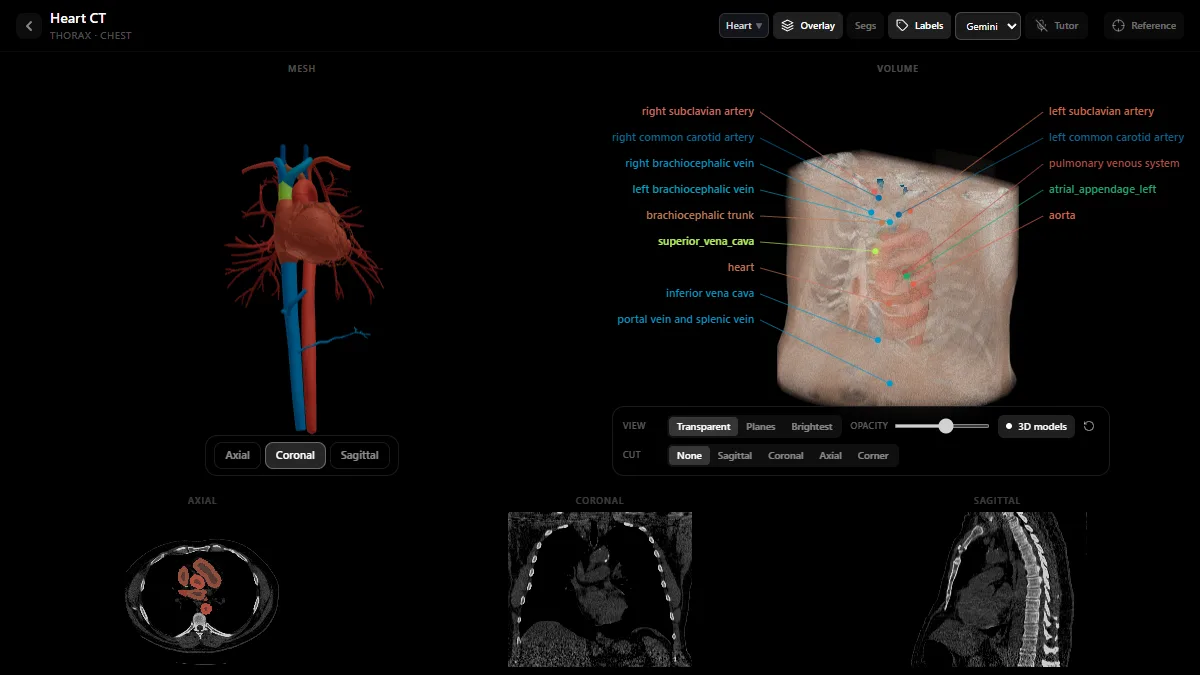
We make DecodeMed AI. This guide draws on published product features and uses a sample tutoring exercise you can run yourself.
Which USMLE AI tutor fits the way you study?
| Tutor | What it works with | How it fits into review |
|---|---|---|
| DecodeMed AI | Interactive 3D anatomy, CT, MRI, histology and ECG atlases | You can point out a feature on a teaching image and check it against the atlas. The website has a recorded answer and sample quiz. Pro includes interactive tutoring within its credit allowance. |
| UWorld UAsk | UWorld’s medical review content | UWorld includes its assistant in its USMLE courses. UWorld feature documentation |
| AMBOSS AI Mode Learning | AMBOSS library articles and Qbank questions | The chat can link to related study material inside AMBOSS. AMBOSS help center |
| ChatGPT Study Mode | General guided conversations | The study mode can ask questions and give hints. OpenAI help center |
Give each tutor the same five-minute exercise
Pick a concept you can already verify in your notes. For example, use sensitivity and positive predictive value. The synthetic numbers below give you a known answer so you can judge how the tutor teaches as well as whether it gets the math right.
A tutoring prompt you can compare across tools
In a made-up study, 100 people have the condition and 80 of them test positive. Among 100 people without the condition, 20 test positive. Ask me for sensitivity first. Wait for my answer. Then ask me for positive predictive value. If I get stuck, ask me who belongs in the denominator before giving any numbers. Once I answer both, give me a new example where the two percentages differ.
Both percentages are 80% in the first exercise, but the denominators represent different groups. Sensitivity uses the 100 people with the condition. Positive predictive value uses the 100 people who tested positive. For the follow-up, change false positives from 20 to 40. Sensitivity stays at 80% and positive predictive value drops to about 67%.
- Timing. Did the tutor let you commit to an answer before revealing it?
- Feedback. Did it identify who was in the denominator or simply repeat the formula?
- Transfer. Could you solve the follow-up independently?
- Verification. Could you trace the explanation to a reference, your own calculation or an atlas image you could inspect?
Try a visual USMLE tutoring task
Open a normal 12-lead tracing in the DecodeMed ECG atlas. Find the P wave and the start of the QRS complex in lead II. Ask the tutor to explain the interval between those landmarks, then try to point them out on another beat. A response that helps you locate the interval gives you something concrete to check. DecodeMed ECG atlas
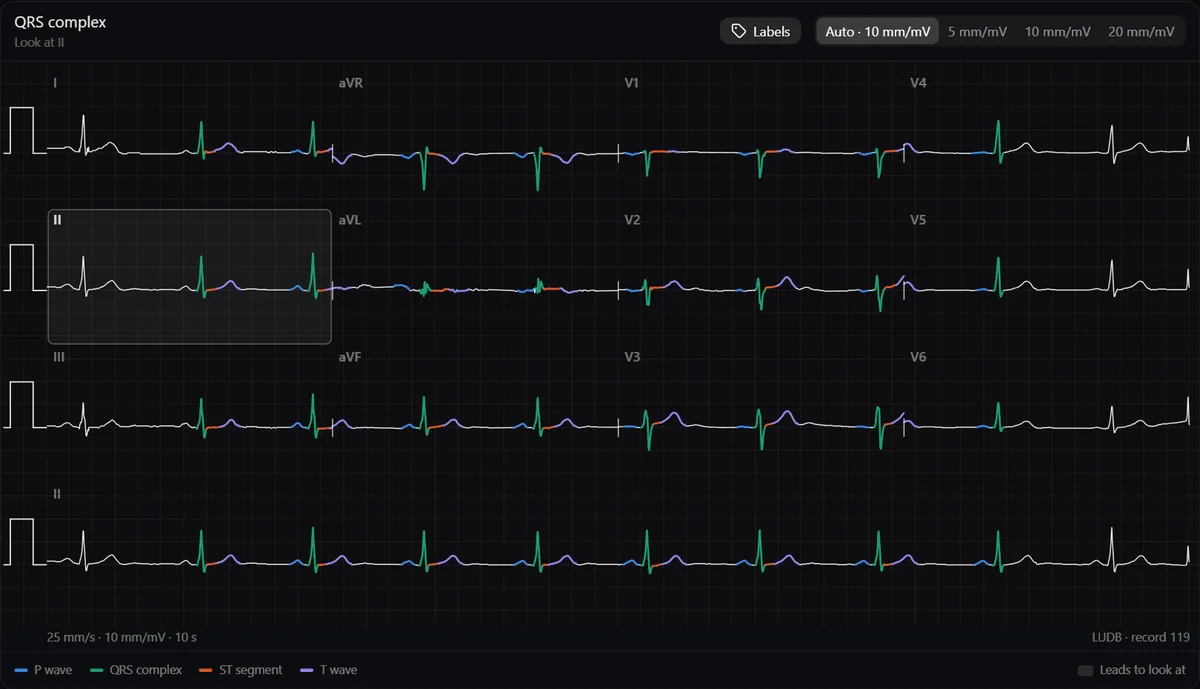
For more study workflows, see the Step 1 AI tutor guide, Step 2 CK clinical reasoning guide and USMLE AI tools comparison.
Frequently asked questions
What is the best AI tutor for USMLE anatomy and imaging?
DecodeMed AI is the option in this comparison designed around interactive medical atlases. Try an anatomy or imaging example and check whether you can identify the same landmark independently afterward.
Is an AI tutor worth paying for if I already have a Qbank?
Try DecodeMed’s recorded answer and sample quiz first. Interactive tutoring may make sense if you regularly need help identifying structures on scans or slides.
How do I know if an AI tutor is helping my USMLE prep?
Use it to review one recurring mistake, then try a fresh question unaided. Look for correct reasoning you can explain and reproduce across several sessions.