Best AI Tutor for USMLE Step 1 Anatomy and Mechanisms
By the DecodeMed Team5 min read
Use the DecodeMed web tutor for Step 1 anatomy, histology and the mechanisms behind a missed question. Start with an atlas you can inspect or a concept you can verify in your notes. Make a prediction, explain how you got there and use a fresh practice question to see whether the explanation carries over.
Choose the tutor based on what you missed
Step 1 tests whether you can apply foundational science to a problem. The official outline organizes it by organ system and process. After a missed question, use those two dimensions to name the gap precisely. “Renal physiology and filtration” gives a tutor a better starting point than “teach me renal.” USMLE Step 1 exam content
| What you missed | Ask the tutor to do this | How to check your progress |
|---|---|---|
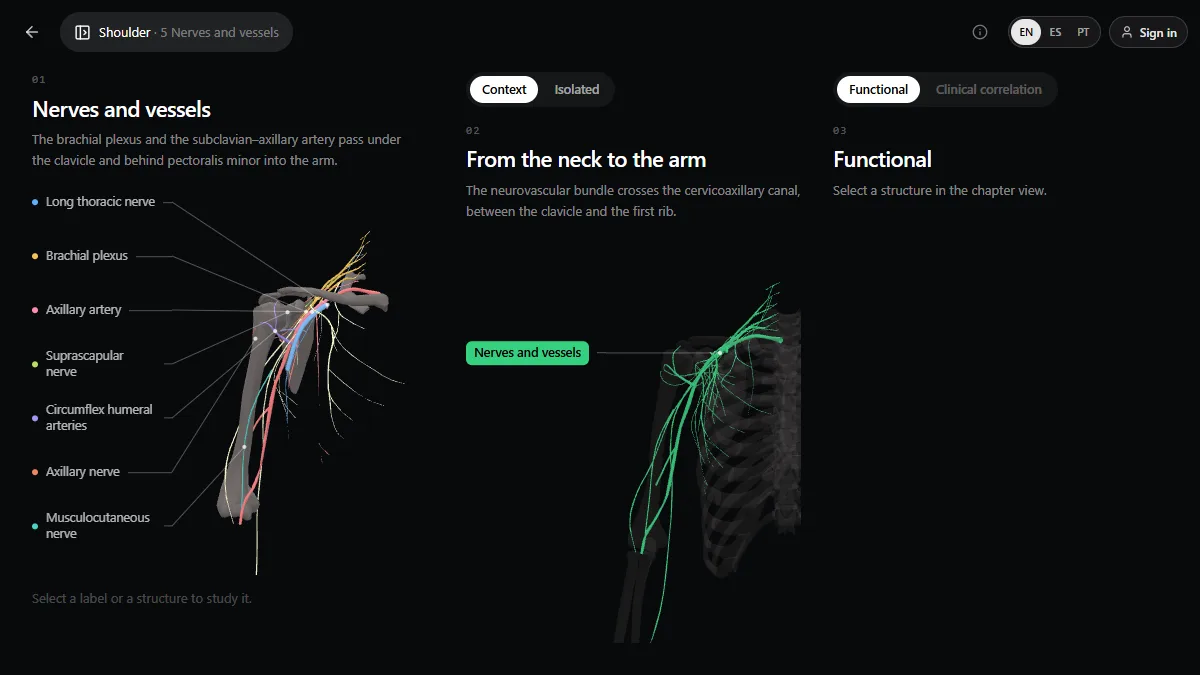
| You could name a nerve but could not locate it | Show one landmark on a 3D model, then give a clue for a neighboring nerve | Find both with labels hidden or look away and sketch their approximate paths |
| You memorized a mechanism but predicted the wrong direction | Change one input and ask what changes first or which way a variable moves | Explain each link aloud and solve a second example that changes a different input |
| You confused two structures on a histology slide | Ask which feature to look for at low power, then what to check at higher power | Identify that feature on a second field of the slide before opening the annotations |
A worked Step 1 anatomy drill
Imagine a shoulder-injury vignette in which weakness follows a lesion near the surgical neck of the humerus. Before looking at the model, name the nerve most closely associated with that landmark and predict one motor finding.
The axillary nerve passes near the surgical neck and supplies the deltoid. A lesion can weaken shoulder abduction, especially after initiation. To test whether you can apply the idea, cover the label and trace the nerve on the model. Then switch the question to scapular winging and locate the long thoracic nerve. Brachial plexus anatomy and injury patterns
Practice finding a structure before naming it
Help me review the axillary nerve on the shoulder model. Ask me for a nearby bony landmark and one weak movement I would predict. Wait for both answers. Then point out the structure in the atlas and ask a new question about a different nerve in the same region. Say explicitly if the atlas view is unavailable.
Work backward from a mechanism error
Use this concept and the explanation from my own notes. Ask me which variable changes first and in which direction. Wait for my reasoning. Point out the first incorrect link, then give an original example that changes one input. Flag any explanation that my notes do not support.
Keep the extra review short enough to repeat
After a practice block, choose one visual miss and one mechanism miss that are likely to recur. Spend about five minutes on each. Write a recall question in your own words and try it the next day before opening the atlas or chat. If you get it right, try the same concept in a different presentation.
Explore 3D anatomy, histology and scan examples in DecodeMed’s AI tutor or start directly with the histology atlas. When you need a readiness check, use the appropriate NBME self-assessment and practice with the official USMLE materials. NBME self-assessments · USMLE practice materials
Build this into your Step 1 study schedule or compare tutoring formats in the USMLE AI tutor guide.
Frequently asked questions
Is ChatGPT useful for USMLE Step 1?
It can act as a questioner while you explain a mechanism or work through a calculation. Verify the medical content against your course material or Qbank explanation and use an actual atlas for image-identification practice.
What is a good way to study Step 1 images with AI?
Start on a labeled image or model, hide the answer, and ask the tutor for a landmark-based clue. Then identify the finding again on another field, slice or orientation.
Should I use an AI quiz to decide when I am ready for Step 1?
Use NBME’s Comprehensive Basic Science Self-Assessment as part of a readiness check. Use short AI quizzes to revisit individual errors between formal assessments.