The Best Medical Search Engines and AI Tools for Doctors in 2026
For a practising doctor, the best medical search engine is the one that gives a trustworthy answer in under a minute. In 2026 that means a curated clinical reference (UpToDate or DynaMed), an AI evidence engine such as OpenEvidence where it is available, and PubMed and Cochrane when the question is new or disputed.
What a doctor needs from a search engine
- Speed at the point of care: an answer between two patients, not a reading list.
- Visible sources: every claim traceable to a guideline or a study.
- Currency: content that is reviewed when the evidence changes.
- Privacy: no patient-identifiable data sent to a tool your institution has not approved.
The best medical search engines for doctors
1. UpToDate
Best for: graded, expert-written answers at the point of care
The most widely used clinical reference. Topics are written and updated by specialists, and its Expert AI feature answers questions using UpToDate’s own content. Subscription, usually through a hospital or institution.
2. OpenEvidence
Best for: fast AI answers with citations
It answers a clinical question in a paragraph, with references to guidelines and journal articles. It is offered to verified clinicians and availability depends on the country, so check whether you can register where you practise.
3. DynaMed
Best for: concise, systematically updated evidence summaries
EBSCO’s clinical reference, known for brief topics and explicit levels of evidence. Its Dyna AI feature answers from DynaMed content; availability varies by region.
4. PubMed
Best for: the primary literature
Use Clinical Queries to restrict a search to therapy, diagnosis or prognosis studies, and filter for systematic reviews when time is short. Free.
5. Cochrane Library
Best for: whether an intervention works
Systematic reviews with a clear statement of how certain the evidence is. Free in many countries through national licences.
6. Trip Database
Best for: guidelines and evidence summaries in one search
A clinical search engine that ranks results by level of evidence, with guidelines and systematic reviews first. The basic search is free.
7. AMBOSS
Best for: quick refreshers outside your specialty
Written for students and residents, which makes it efficient when you need the essentials of an unfamiliar condition.
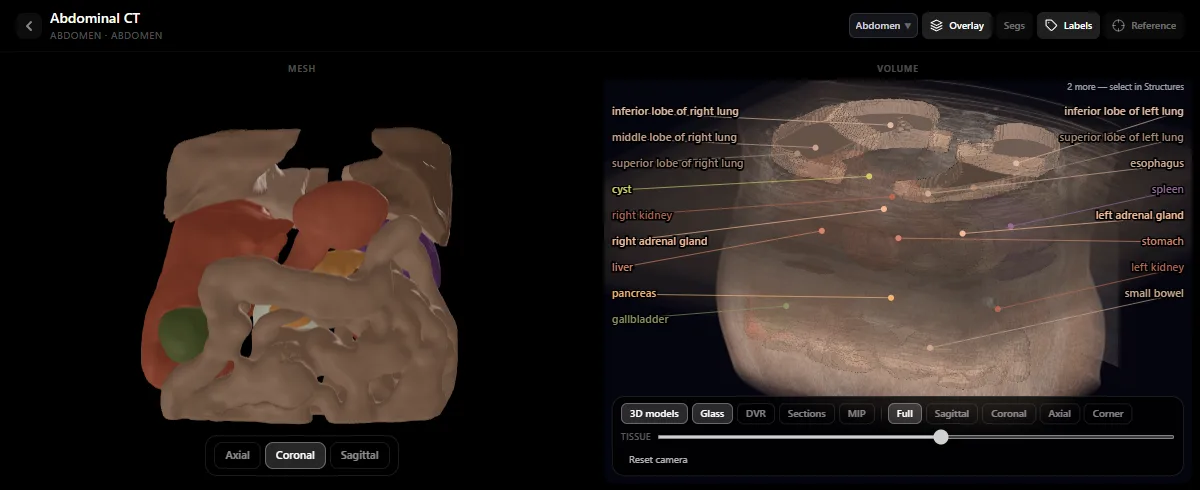
8. RadioAnatomy
Best for: checking anatomy before reading a scan or planning a procedure
When the question is where a structure lies and how it looks on CT or MRI, an atlas answers faster than text. The radiology atlas and the anatomy atlas are free in the browser.
Comparison at a glance
| Tool | Type | Access |
|---|---|---|
| UpToDate | Curated clinical reference with AI answers | Subscription, often institutional |
| OpenEvidence | AI evidence engine | Free for verified clinicians, depends on country |
| DynaMed | Curated clinical reference with AI answers | Subscription |
| PubMed | Literature database | Free |
| Cochrane Library | Systematic reviews | Free in many countries |
| Trip Database | Evidence search engine | Free basic search |
Using AI search safely in clinical practice
- Treat the AI answer as a pointer, not a decision. Open the cited guideline or trial before you act on it.
- Do not enter patient-identifiable information unless your institution has approved the tool for it.
- Check doses and interactions in a drug reference, not in a generated paragraph.
- Prefer your national guideline when it differs from a source written for another health system.
Frequently asked questions
What is the best medical search engine for doctors?
For most clinical questions, a curated reference such as UpToDate or DynaMed. OpenEvidence is a fast AI alternative where it is available, and PubMed and the Cochrane Library remain the place to go when the question is new or the summaries disagree.
Is OpenEvidence free for doctors?
At the time of writing it is free for verified healthcare professionals in the countries where it operates. Verification and availability differ by country, so check its sign-up page.
Can doctors use ChatGPT for clinical questions?
A general chatbot can help draft or explain, but it is not a clinical reference: it may be out of date, it can invent citations, and it is not designed for patient data. Use a tool that answers from curated medical sources and shows them.
RadioAnatomy is our own product, so weigh what we say about it accordingly. We have no affiliate or commercial relationship with the other tools listed.
Get the RadioAnatomy app
Anatomy, radiology and histology in one app, on the App Store and Google Play.