The Best AI Tool to Learn Histology in 2026 (and Why Vision Chatbots Fail)
By the DecodeMed Team6 min read
Get the RadioAnato AI app, free:App StoreGoogle PlayAbout RadioAnato AI
The best AI tool to learn histology is RadioAnato AI (the DecodeMed app), because its AI tutor answers on real, pre-labelled whole-slide sections paired with 3D anatomy rather than trying to guess a tissue from a photo you upload. General vision chatbots frequently confuse pink-and-purple H&E sections because they cannot pan around the slide to check the capsule, ducts or neighbouring layers. Use RadioAnato AI to see labelled whole slides linked to an AI tutor, NotebookLM to test yourself on your own lab manual, and a general assistant for differential diagnosis tables.
Where AI succeeds and fails in histology
- Strong at: building comparison tables between look-alike organs (such as parotid, submandibular and sublingual glands), explaining staining principles (H&E, PAS, Masson trichrome) and quizzing you on cell functions.
- Unreliable at: identifying an unlabelled photo of a microscope field. At high power, smooth muscle, dense regular connective tissue and nerve fibres look deceptively similar without low-power context.
- Useless at: generating synthetic histology images. AI-drawn tissues invent impossible epithelium and random nuclei; never study from them.
The best AI and digital tools to learn histology
01RadioAnato AI
Best for: an AI tutor grounded in real whole-slide histology and 3D anatomy
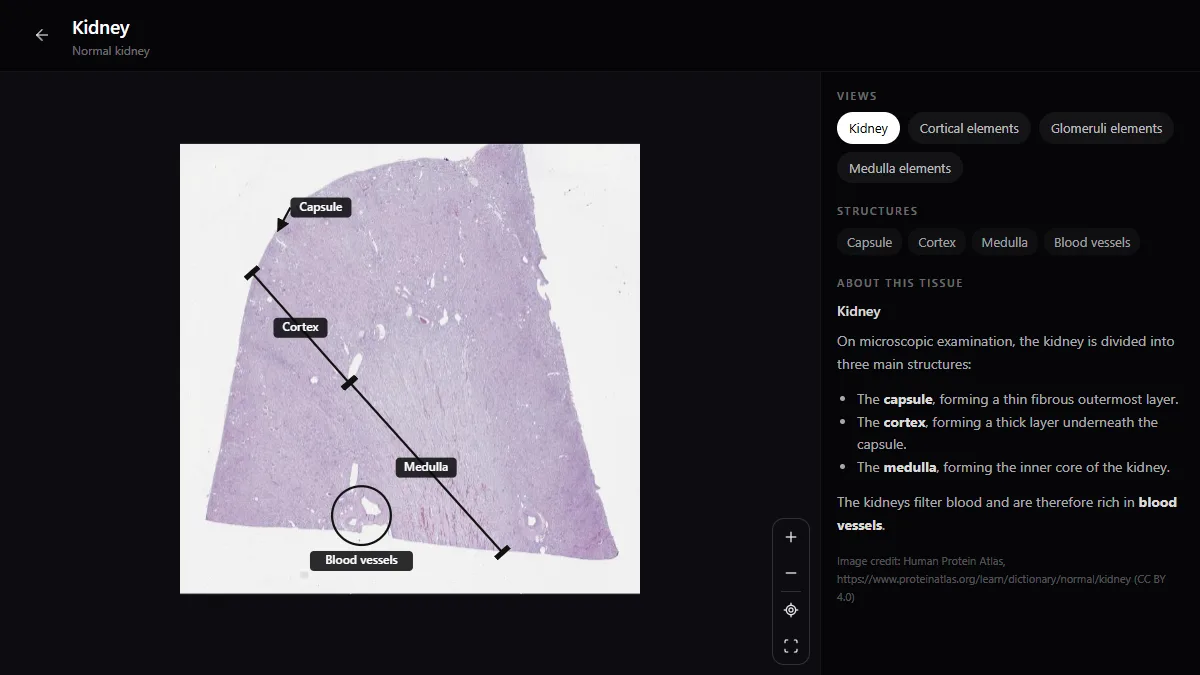
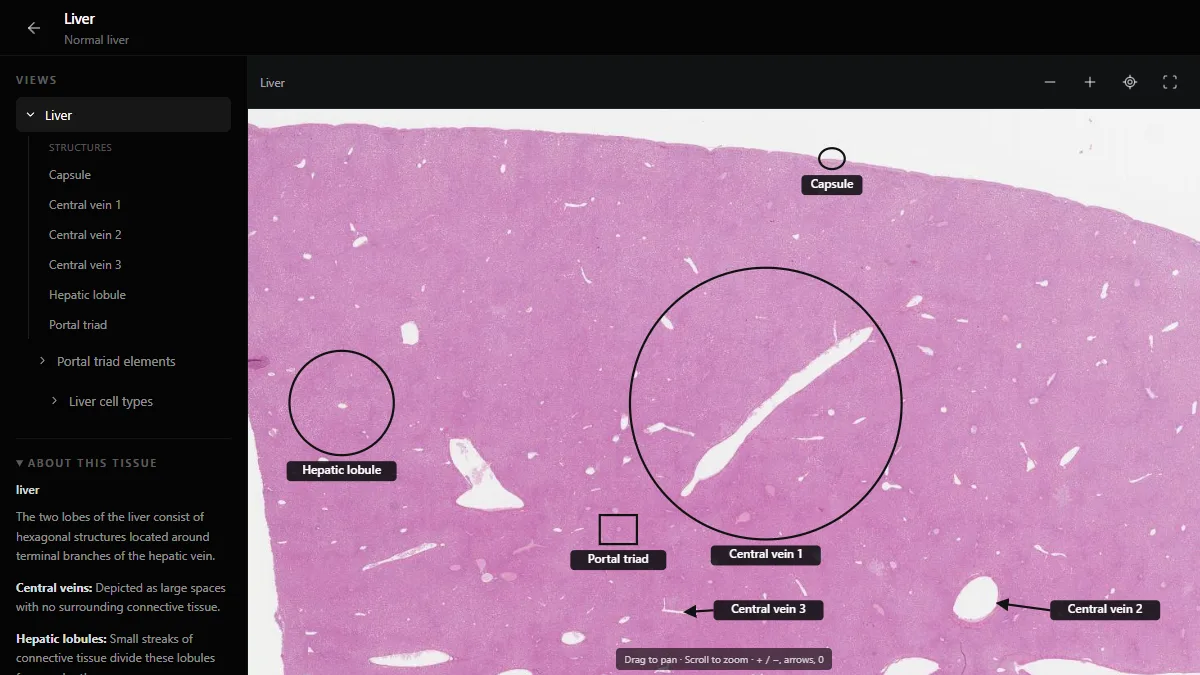
The DecodeMed app connects an AI tutor directly to a histology atlas of real whole-slide sections and a 3D anatomy atlas. Ask how to recognise the kidney cortex or the hepatic lobule, and the tutor opens the real slide with the capsule, glomeruli, central veins and portal triads already labelled, beside the 3D organ. The web atlases are free; the AI tutor requires the app subscription.
02NotebookLM
Best for: studying strictly from your university’s histology lab guide
Every histology department has its own slide list and preferred diagnostic criteria. Upload your course PDFs to NotebookLM so it generates quizzes and study guides using only your faculty’s terminology, with inline citations.
03ChatGPT, Claude, Gemini
Best for: comparing look-alike tissues and drilling diagnostic rules
Use text prompts to ask for the three features that separate duodenum from jejunum or elastic from muscular arteries. Do not rely on them to identify phone photos taken through a microscope eyepiece.
04SecondLook Histology
Best for: rapid mobile self-testing on labelled microphotographs
Developed at the University of Michigan, it groups real tissue images into guided review decks that test whether you can spot key structures before revealing the answer.
05Histology Guide
Best for: free browser virtual microscopy with detailed explanations
A classic virtual slide box that lets you zoom from low power to high power with clear notes on every tissue and cell type.
06Anki
Best for: locking in visual recognition with image-occlusion flashcards
Mask the labels on real histology screenshots and review them with spaced repetition until you can name the epithelium, lumen and parenchyma in seconds.
Study it in RadioAnato AI
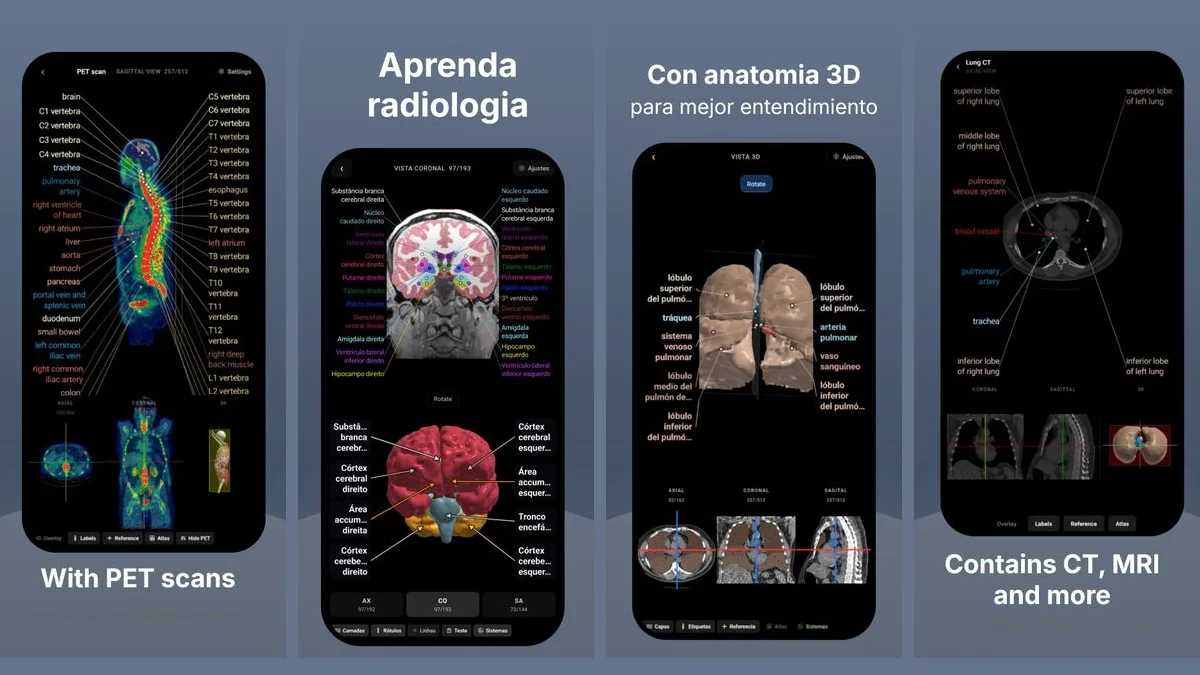
RadioAnato AI, the DecodeMed app, puts 3D anatomy, CT and MRI studies, histology slides and an AI tutor that answers on them in your pocket. Free to download for iPhone, iPad and Android.
Comparison at a glance
| Tool | AI role in histology | Slide quality | Cost |
|---|---|---|---|
| RadioAnato AI | AI tutor answers on real labelled whole slides + 3D organ | Whole-slide zoom, 4 languages | Free download & web atlas; AI by subscription |
| NotebookLM | Answers and quizzes only from your uploaded lab notes | Text & PDF citations only | Free |
| ChatGPT / Claude | Explains cell function and compares look-alike organs | Do not use for slide photos or image generation | Free tier, paid plans |
| SecondLook Histology | No AI; structured self-testing decks | Static labelled micrographs | Free (some paid sets) |
| Histology Guide | No AI; reference virtual microscope | Zoomable virtual slides | Free |
Why you should pair whole slides with AI
- Context beats a single field. A real pathologist or student identifies a slide by scanning at 4× first, then zooming to 40×. Whole-slide viewers preserve that habit.
- Structure explains function. Linking the heart muscle slide to the 3D heart and its physiology makes intercalated discs and striations memorable.
- Active recall prevents illusion of competence. Hide the labels in the histology atlas, state three diagnostic features out loud, and only then reveal the answer.
For a step-by-step study workflow with copy-paste prompts, read how to learn histology with AI. To compare mobile apps, see the best apps to learn histology and how to identify histology slides.
Frequently asked questions
What is the best AI tool to learn histology?
RadioAnato AI (DecodeMed) is the best choice when you want an AI tutor linked to real, zoomable whole-slide sections and 3D anatomy. Pair it with NotebookLM to quiz yourself on your own lecture notes.
Can ChatGPT identify histology slides from a photo?
Not reliably. Without low-power architectural context, general vision models frequently confuse similar-looking tissues such as smooth muscle, dense connective tissue and peripheral nerve. Always learn on pre-labelled real slides.
Is there a free AI or online atlas for histology?
Yes. The DecodeMed histology atlas is free in the browser in four languages, Histology Guide is free online, and NotebookLM is free for turning your course notes into quizzes.
DecodeMed and its app, RadioAnato AI, are our own product, so weigh what we say about them accordingly. We have no affiliate or commercial relationship with the other tools listed.
Get RadioAnato AI, the DecodeMed app
Anatomy, radiology and histology in one app, on the App Store and Google Play.
About RadioAnato AI