ECG Practice Cases With Answers: Where to Find Them and How to Use Them
By the DecodeMed Team6 min read
Get the RadioAnato AI app, free:App StoreGoogle PlayAbout RadioAnato AI
The fastest way to get good at ECGs is to read a real tracing, commit to an answer, then check it. The DecodeMed ECG Atlas lets you do that on real 12-lead ECGs by hiding the marks and then showing them; Hampton’s 150 ECG Cases and the LITFL case series are the best sources of cases with explained answers.
How to work through a case
- Cover the answer and read the tracing in your usual order: rate, rhythm, axis, intervals, P, QRS, ST, T.
- Write one line: the rhythm, then the main finding, then what you would do.
- Check and note what you missed, not only whether the diagnosis was right.
- Repeat the pattern on a second tracing a few days later.
Case 1: describe this ECG
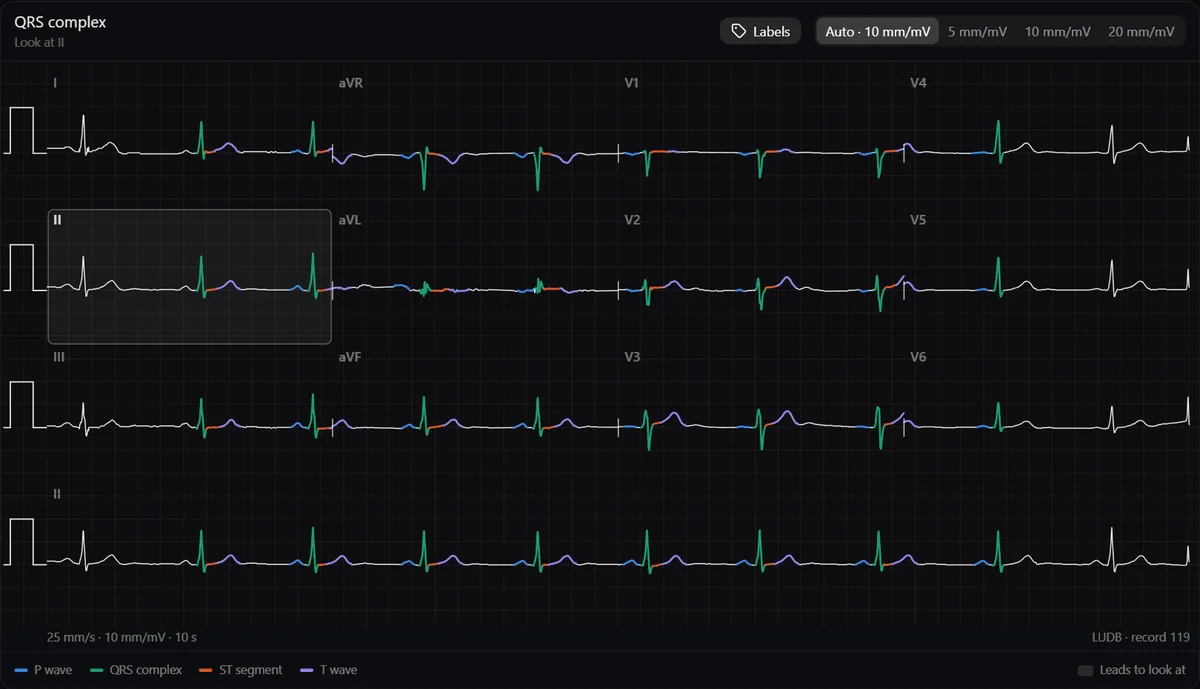
Look at the 12-lead ECG at the top of this page and read it before you look at the answer.
Answer: sinus rhythm at about 60 bpm, normal axis, PR about 160 ms, QRS about 96 ms, QT about 390 ms with a QTc around 390 ms. Normal ST segments and T waves. A normal ECG. These are the values measured on the tracing in the atlas.
Case 2: what is the conduction problem?
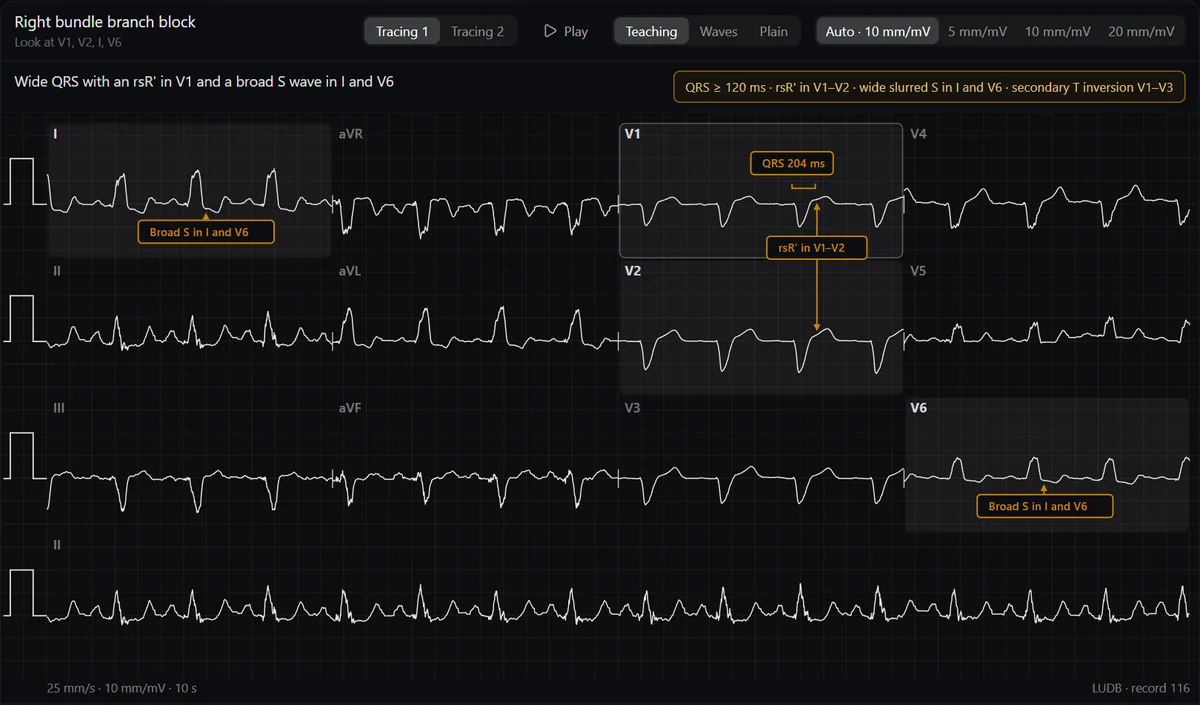
Answer: a QRS of 120 ms or more, an rsR′ in V1–V2 and a broad, slurred S wave in I and V6: right bundle branch block. The right ventricle is activated late through the muscle, which adds the second R in the right chest leads.
Where to find more cases with answers
01DecodeMed ECG Atlas
Best for: real 12-lead tracings to test yourself
Switch to the Plain view to read a tracing without help, then to Teaching to see the arrows, the criteria and what changes. Each tracing shows its measured rate, intervals and axis to check your numbers.
02150 ECG Cases (Hampton)
Best for: the classic case book
A short history and a full ECG per case, then the interpretation and what to do. The newest edition has 160 cases.
03LITFL ECG Library
Best for: free cases with explanations
Free case-based series and an example for almost every finding, written by emergency physicians.
04EKG SecondLook
Best for: free question-based practice
University of Michigan self-assessment with an explanation after each question.
05ECG Academy
Best for: a quiz app with hundreds of cases
An iPhone app with a library of real cases and a quiz mode.
06ECG Guru
Best for: tracings with discussion
A free collection of ECGs with discussion, built for instructors and useful for students.
Study it in RadioAnato AI
RadioAnato AI, the DecodeMed app, puts 3D anatomy, CT and MRI studies, histology slides and an AI tutor that answers on them in your pocket. Free to download for iPhone, iPad and Android.
If the method is new to you, start with how to learn ECG from scratch and the normal values.
Frequently asked questions
Where can I practise ECG cases for free?
The LITFL ECG Library, EKG SecondLook and ECG Guru are free, and the DecodeMed ECG Atlas lets you test yourself on real 12-lead tracings by hiding the teaching marks.
What is the best ECG case book?
Hampton’s 150 ECG Cases (160 in the newest edition), with a history and an explained answer for every tracing.
How many ECGs should I practise?
Around ten a day for a few weeks builds the habit; after that, read every ECG you see on the ward and compare with the report.
DecodeMed and its app, RadioAnato AI, are our own product, so weigh what we say about them accordingly. We have no affiliate or commercial relationship with the other tools listed.
Get RadioAnato AI, the DecodeMed app
Anatomy, radiology and histology in one app, on the App Store and Google Play.
About RadioAnato AI