The Best AI to Learn Radiology in 2026: CT, MRI and Cross-Sectional Anatomy
By the DecodeMed Team7 min read
Get the RadioAnato AI app, free:App StoreGoogle PlayAbout RadioAnato AI
The best AI to learn radiology is RadioAnato AI (the DecodeMed app), because its AI tutor teaches on real, scrollable CT and MRI volumes with 3D organ models—not a chatbot guessing from a single screenshot. Because cross-sectional imaging depends on following vessels, ducts and planes from slice to slice, general vision chatbots routinely misidentify structures on a lone image. Use RadioAnato AI to ask questions directly on labelled CT/MRI volumes and 3D anatomy, OpenEvidence for imaging guidelines and appropriateness criteria, and NotebookLM to turn your radiology lectures into quizzes.
What AI can and cannot do in radiology education
- Good at: explaining imaging physics (Hounsfield units, T1 vs T2 weighting), listing systematic search checklists, and walking through differential diagnoses by compartment (such as anterior vs middle mediastinum).
- Unreliable at: reading a single CT or MRI screenshot uploaded into a chat window. Without scrolling above and below the slice, even a human radiologist cannot reliably tell a tortuous vessel from a lymph node or trace a ureter.
- Dangerous for: clinical diagnosis on unvalidated chatbots. Consumer LLMs are not FDA/CE-cleared DICOM readers and should never be used on patient studies.
The best AI and digital tools to learn radiology
01RadioAnato AI
Best for: an AI tutor that answers on real scrollable CT/MRI volumes and 3D models
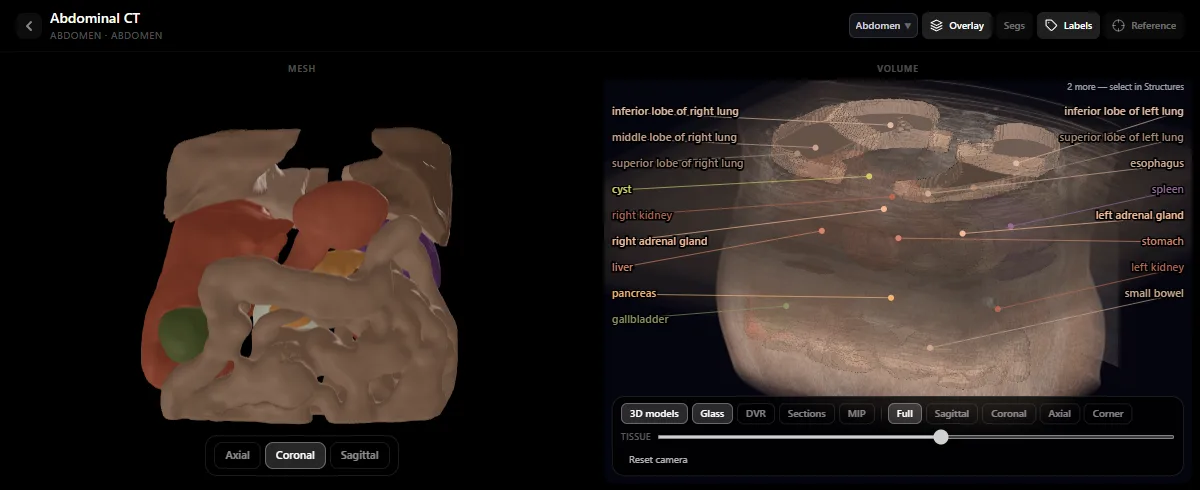
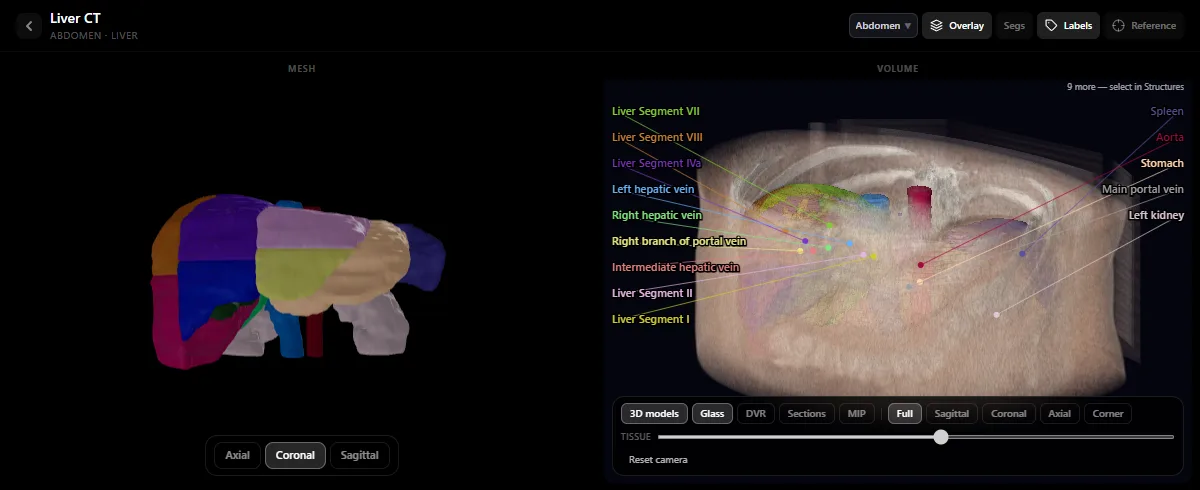
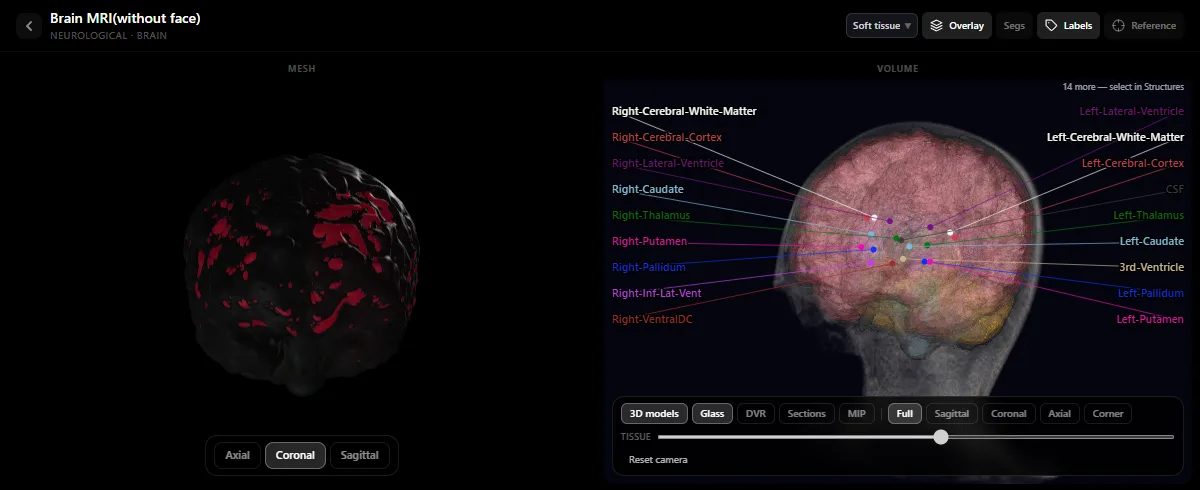
The DecodeMed app links an AI tutor to a real radiology atlas and 3D anatomy atlas. Ask about the Couinaud liver segments, the basal ganglia or the mediastinal vessels, and the AI highlights the structures on the 3D volume while you scroll the axial, coronal and sagittal slices below. The web atlases are free; the AI tutor requires the app subscription.
02OpenEvidence
Best for: evidence-based answers on which imaging study to order
Searches peer-reviewed literature and clinical guidelines to answer questions such as when to order a non-contrast CT versus an MRCP, with direct citations.
03NotebookLM
Best for: quizzing yourself on your own radiology syllabus and notes
Upload your radiology rotation handouts or textbook notes and ask NotebookLM to generate case vignettes and checklists grounded strictly in your course material.
04ChatGPT, Claude, Gemini
Best for: practising structured reporting, physics and differential diagnoses
Ask them to drill you on the Fleischner criteria, BI-RADS categories or why subacute blood is bright on T1. Always verify anatomical locations on a scrollable atlas.
05Radiopaedia
Best for: scrollable clinical pathology cases and reference articles
While not an AI tool, Radiopaedia’s tens of thousands of scrollable patient stacks are the essential companion once you have learned normal anatomy and want to see real pathology.
06IMAIOS e-Anatomy
Best for: exhaustive subspecialty anatomical labelling
The classic paid reference for residents who need every small arterial branch or skull-base foramen labelled across CT and MRI.
Study it in RadioAnato AI
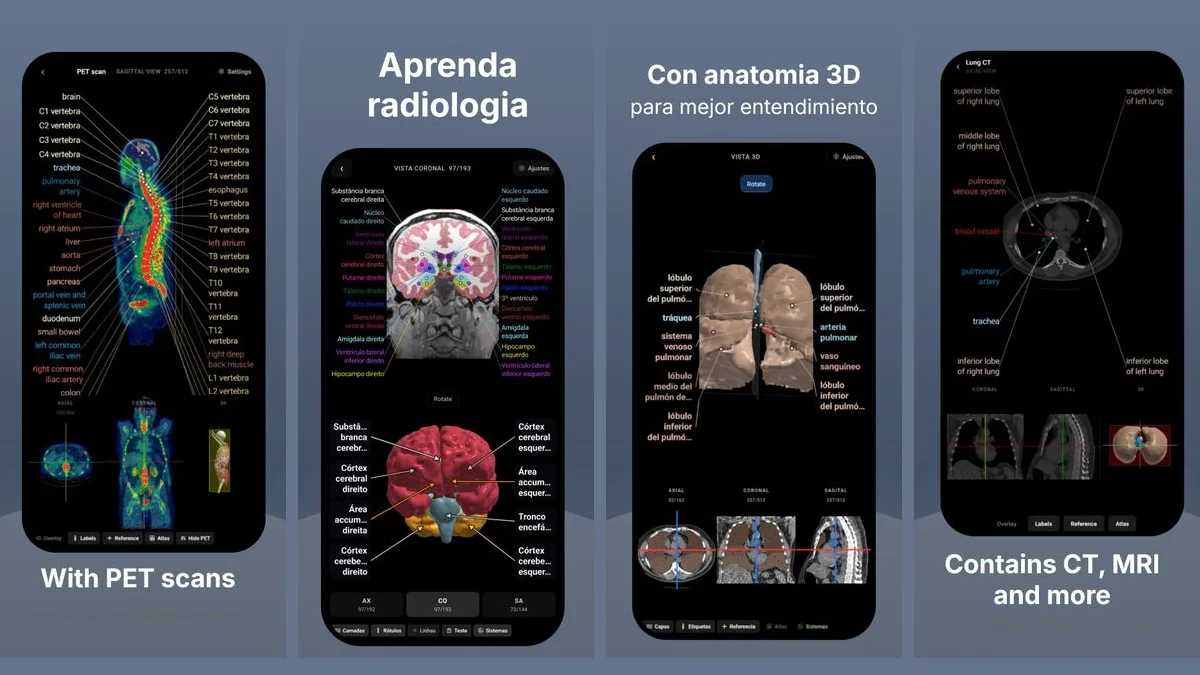
RadioAnato AI, the DecodeMed app, puts 3D anatomy, CT and MRI studies, histology slides and an AI tutor that answers on them in your pocket. Free to download for iPhone, iPad and Android.
Comparison at a glance
| Tool | Strength for learning radiology | Shows scrollable CT/MRI | Cost |
|---|---|---|---|
| RadioAnato AI | AI tutor linked to 3D models + labelled CT/MRI stacks | Yes (axial, coronal, sagittal + 3D) | Free download & web atlas; AI by subscription |
| OpenEvidence | Imaging guidelines & clinical literature with citations | No (text search) | Free for verified clinicians/students |
| NotebookLM | Quizzes and summaries from your own uploaded PDFs | No (text only) | Free |
| ChatGPT / Claude | Physics explanations, differentials & oral-exam drills | No (do not rely on single-slice uploads) | Free tier, paid plans |
| Radiopaedia | Encyclopedia & real pathology stacks | Yes (case stacks) | Free |
How to combine AI with real scans
- Master normal cross-sectional anatomy first. Before looking for pathology, spend ten minutes scrolling a normal abdominal CT or chest CT in the radiology atlas.
- Use 3D alongside 2D slices. Seeing the Couinaud liver segments in 3D makes the portal and hepatic vein planes on axial slices click immediately.
- Use AI for the “why”, not the “where”. Let the atlas show you *where* a structure sits; ask AI *why* it looks bright on T1 vs T2 MRI or what Hounsfield window brings it out.
For a step-by-step study routine and copy-paste prompts, read how to learn radiology with AI, and compare mobile viewers in the best apps to learn radiology.
Frequently asked questions
What is the best AI to learn radiology?
RadioAnato AI (DecodeMed) is the best choice for learning cross-sectional anatomy with AI because its tutor answers on real, scrollable CT and MRI volumes paired with 3D organ models. Pair it with OpenEvidence for imaging guidelines and ChatGPT or NotebookLM for differential diagnosis drills.
Can ChatGPT read a CT scan or MRI?
No. Uploading a single screenshot of a CT or MRI to a general chatbot is unreliable because cross-sectional imaging requires scrolling through contiguous slices and adjusting windows. Never use general chatbots to interpret patient scans.
Is there a free tool to learn CT and MRI anatomy?
Yes. The DecodeMed radiology atlas is free in the browser and includes labelled CT and MRI volumes with 3D organ reconstructions, and Radiopaedia offers free pathology cases.
DecodeMed and its app, RadioAnato AI, are our own product, so weigh what we say about them accordingly. We have no affiliate or commercial relationship with the other tools listed.
Get RadioAnato AI, the DecodeMed app
Anatomy, radiology and histology in one app, on the App Store and Google Play.
About RadioAnato AI